Teddy Roosevelt Terrier
The Teddy Roosevelt Terrier is an American breed that shares an early history with the American Rat Terrier, Fox Paulistinha, and Tenterfield Terrier. Today these lively, playful dogs have another skill beyond delighting their humans—they can locate black truffles growing several inches below tree roots.
Interested in discovering if your dog is a Teddy Roosevelt Terrier?
Check out Wisdom Panel's DNA tests.
Teddy Roosevelt Terrier Traits
General Appearance
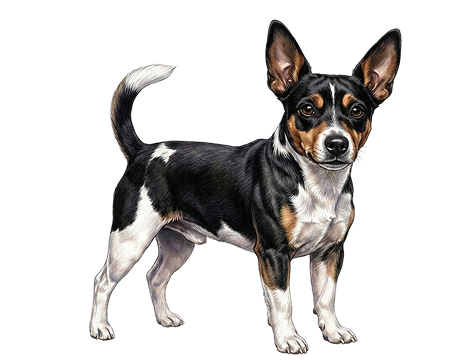
The Teddy Roosevelt Terrier has a low-set, muscular, and small-to-medium sized. Their body is longer than it is tall, and they have v-shaped ears and noticeably shorter legs than the related American Rat Terrier.
Coat and Coloring
Teddy Roosevelts have a short, dense, smooth or slightly hard coat. Their base color is always white, with coat patterns typically described as piebald or tuxedo. Color combinations include: black and white, white and tan, white and blue, white and chocolate, white and fawn, white and lemon, white and red, tricolor, sable and white, and others. Solid white coats also occur.
Distinctive Physical Traits
This breed has a broad, slightly domed, blunt wedge-shaped head proportionate to their body size. Their ears are set at the outside edges of the skull and may be erect, semi-erect, or button. They have oval eyes set obliquely, with color ranging from light to dark and corresponding to their coat color. Their tail may be docked, a natural bobtail, or a natural tail carried in an upward curve.
Teddy Roosevelt Terrier Temperament
The Teddy Roosevelt Terrier is a friendly, affectionate, and playful breed. These loyal pups are deeply devoted to family, and often described as a one-person or one-family dog. They tend to be reserved with strangers but not aggressive, and they get along well with children, cats, and other dogs when raised with them. They do have a high prey drive and will chase squirrels, rats, cats, and small animals. Typical of terriers, they can be vocal and love to dig. Their clownish personality will make their pet parents laugh daily, and they are usually game to curl up on the couch for a good snuggle.
Teddy Roosevelt Terrier History
The Teddy Roosevelt Terriers descended from terriers brought to the United States by English miners and other working-class immigrants in the 19th century. These included crosses between the Smooth Fox Terrier, Manchester Terrier, Bull Terrier, Beagle, Whippet, Italian Greyhound, and the now-extinct English White Terrier. These dogs served as farm ratters and pest controllers.
Over time, two distinct leg-length types emerged from the Rat Terrier population—the standard longer-legged type and a shorter-legged, more muscular 'bench-legged' type. The short-legged variety was named in honor of American President Theodore Roosevelt, who owned several of these dogs. In fact, his attempts to rid the White House of vermin brought public attention to the breed.
The first breed standard was developed by the Teddy Roosevelt Terrier Club of America in 1995. The UKC recognized it as a breed separate from the Rat Terrier in 1999, and the AKC accepted the breed with full recognition in 2026.
Teddy Roosevelt Terrier Care
Nutrition
To meet the Teddy Roosevelt Terrier's nutritional needs, feed a high-quality dog food formulated for their size, age, and activity level. It's important to avoid overfeeding, as obesity worsens joint problems. To keep portions under control, feed them twice daily and measure or weigh meals. Consult a veterinarian for life-stage-specific guidance as your dog ages.
Grooming
Teddy Roosevelt's coat is relatively low maintenance. They typically need monthly brushing with a soft slicker or firm bristle brush, though during periods of seasonal shedding weekly brushing will likely be needed. You can bathe them every 4–6 weeks or as needed. Rolling in dirt is a favorite post-bath ritual, so limit access to outdoors immediately after you bathe them. To round out their grooming, check and clean ears regularly, trim nails monthly, and develop a regular at-home dental care routine.
Exercise
This breed needs at least 30–40 minutes of daily vigorous exercise, though more is appreciated. They are adaptable to apartment living provided their exercise needs are met. Fun ways to keep them active include long walks, outdoor romps, agility, barn hunt, FastCAT, and fast-paced play. You may be surprised by the unlimited energy these little pups often have. Mental stimulation through games and training is essential alongside physical exercise.
Training
Teddy Roosevelt Terriers are highly intelligent and eager to please. These qualities make them relatively easy to train when positive reinforcement techniques are used. Consistent training is important to achieve desired results, especially with puppies. As with all dogs, early socialization and obedience training will help them develop into confident, well-mannered adult dogs.
Teddy Roosevelt Terrier Genetic Health Conditions
-
Hyperuricosuria
Hyperuricosuria (HUU) is a condition that predisposes affected dogs to the formation of urinary stones, such as kidney or bladder stones.
-
Primary Lens Luxation
Primary Lens Luxation (PLL) is a condition that can cause the lens of the eye to become loose and eventually displace. The disorder is caused by degeneration of the fibers that hold the lens in place.
Knowing if your Teddy Roosevelt Terrier is a carrier or at-risk for these conditions can help you and your veterinarian plan for your pup’s lifelong care. With Wisdom Panel™ Premium, you can get results for over 200 genetic health tests.
Breed Group
Terrier
The Terrier Group ancestors were bred to hunt and kill vermin. They are often characterized as feisty and energetic dogs whose sizes range from fairly small to much larger.