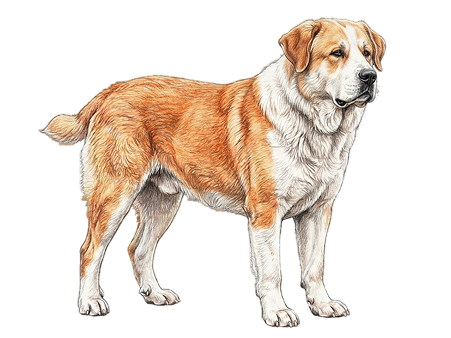
Kazakh Tobet
September 3rd has officially been designated as a National Day of the Kazakh Dog Breeds.
Interested in discovering if your dog is a Kazakh Tobet?
Check out Wisdom Panel's DNA tests.
Kazakh Tobet Traits
General Appearance
The Tobet is robust breed, ideally no taller than the sheep they protect, and of great strength and power. The body is as long as it is tall at the withers, or slightly longer.
Coat and Coloring
The Tobet's coat is short or moderately long with a heavy undercoat. The breed comprises numerous types differing in size, color, head types, and hair types.
Distinctive Physical Traits
Tobets should be visibly unrefined and powerful, with a heavy head, deep-set eyes and visible dewlap. When relaxed, the topline should be slightly concave. The ears are traditionally cropped very short and the tail is docked to 1/3 length.
Kazakh Tobet Temperament
The Tobet is an extremely independent, curious, alert, and composed breed, as they are typically left to protect flocks without human intervention. They are traditionally tested for their willingness and ability to protect premises and fight predators, and leadership type behavior is highly valued.
Kazakh Tobet History
The Kazakh Tobet is one of two Kazakh native breeds, and related to the Central Asian Shepherd Dog. It is a livestock guardian breed whose ancestors originated in a geographical area between the Ural Mountains, the Caspian Sea, Asia Minor, and the northwest border of China. The breed has been historically used by the nomadic peoples of Kazakhstan to guard sheep and goat herds from wolves and other predators.
After the Communist revolution, the Soviet government imported the best breed representatives of local livestock guardian dogs to Russia for military working dog programs, which harmed local populations through crossbreeding with other breeds. Aboriginal livestock guardian dogs and mixes can still be found in Kazakhstan, Kyrgyzstan, Tajikistan, Turkmenistan, Afghanistan, and Uzbekistan, although the Kazakh Tobet is still described as on the brink of extinction.
The preservation of the Tobet, along with the Kazakh Tazy, are currently being managed by Kansonar, the Republican Association of Public Associations of National Hunters and Hunting Entities, along with the government of Kazakhstan, which is spending around $3 million for the protection and promotion of the breeds as part of their national and cultural heritage.
Kazakh Tobet Care
Nutrition
To meet the Tobet's nutritional needs, feed a diet formulated for giant, working breeds. They eat a lot of food each day, but are naturally efficient metabolizers adapted to steppe conditions. Their diet should include adequate protein and fat for coat maintenance and energy. Supplements to support their joint health are recommend. This breed is prone to bloat, so feed multiple smaller meals to reduce the likelihood of this condition.
Grooming
The Tobet's coat requires regular brushing, especially during seasonal periods when they shed their thick undercoat. To round out their grooming, check and clean ears regularly, trim nails monthly, and develop a regular at-home dental care routine.
Exercise
As a working livestock guardian, the Tobet is accustomed to large territories and extensive daily movement guarding flocks.
Training
The Tobet is independent by nature. The Russian National Breed Club developed a temperament test to reveal willingness and ability to protect premises. Titles in Obedience and Protection are also pursued. Understanding your dog's natural strengths can help guide their training.
Breed Group
Middle Eastern and African
While this ancient group shares many of the characteristics of the Hound Group, their origins, as the name would suggest, are concentrated in Africa and the Middle East unlike the hound group that has no true geographic center.


