
Has your cat ever stared intently at an empty corner or suddenly tracked something across a room that you can’t see? While it may seem like cats are tuned into another world, their heightened senses may offer a more scientific explanation.
How cats’ senses differ from humans’
Cats experience their surroundings differently than humans do. Understanding how their senses compare to ours can help you interpret their behaviors.
Cats see better in low light
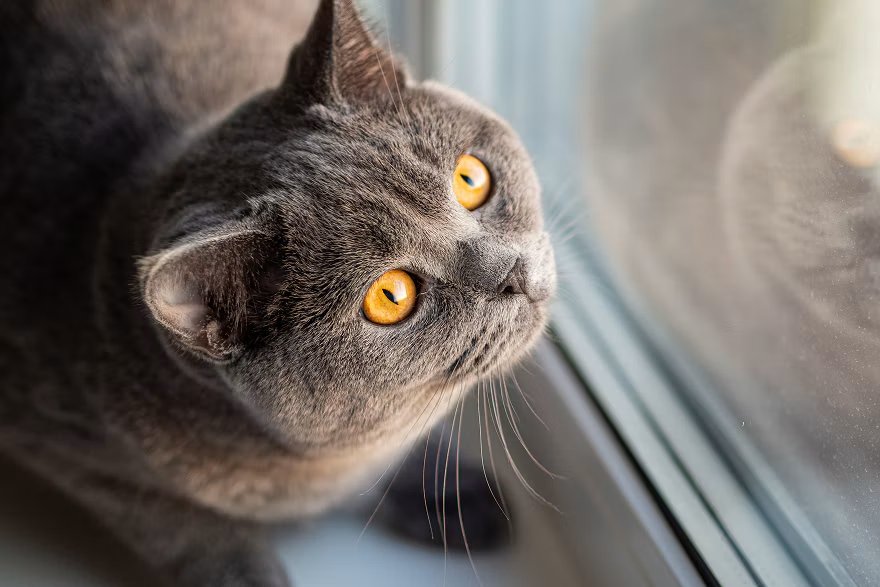
Cats can’t see in complete darkness, but their eyes are much better adapted than ours for seeing in dim conditions. Their retinas contain more rod cells, which are sensitive to light and movement. They also have a reflective layer behind the retina called the tapetum lucidum, which gives incoming light another chance to reach light-sensitive cells. These anatomical features help cats detect movement in low light. For a full breakdown of cats’ night vision, check out our related blog post.
Just because they see better at night doesn’t mean cats outperform humans in every aspect of vision. Their visual acuity isn’t as sharp as ours, and their color perception is more limited. But these differences explain why a tiny movement in a dim room may be much more noticeable to your cat than to you.
Cats hear sounds we can’t
A cat that suddenly looks toward a seemingly quiet room may be responding to sound rather than sight.
Cats have a broad hearing range. One study found that domestic cats could hear frequencies ranging from approximately 48 Hz to 85 kHz. This puts their hearing into the ultrasonic range and well above the roughly 20 kHz upper limit of human hearing. That means noises from insects, electronics, pipes, or other sources may attract your cat’s attention while remaining completely inaudible to you.
A cat’s sense of smell is superior
Smell adds another layer of information. Cats use scent to investigate their surroundings and communicate with other cats. And with roughly 200 million scent receptors compared to 5 million in humans, cats can use their noses to pick up information about their environment that people miss.

Why does my cat stare at nothing?
When you consider all of these sensory differences together, a cat that appears to be staring at “nothing” may actually be paying close attention to something very real.
A reflection from a window, a speck of dust drifting through a beam of light, or a tiny insect can provide enough movement to capture a cat’s attention. Likewise, a buzzing computer monitor, air moving through an HVAC vent, or subtle outdoor sounds may prompt them to stop and focus.
A cat’s predatory instincts also play a role. Domestic cats retain many hunting behaviors from their wild ancestors, including closely watching an area for small movements. What looks like an inexplicable stare may be a cat concentrating on a potential target or investigating a change in their environment.
When staring could signal a health concern
Occasional staring is generally not a reason for concern. But if the behavior is new, frequent, or accompanied by other changes, it’s worth paying closer attention.
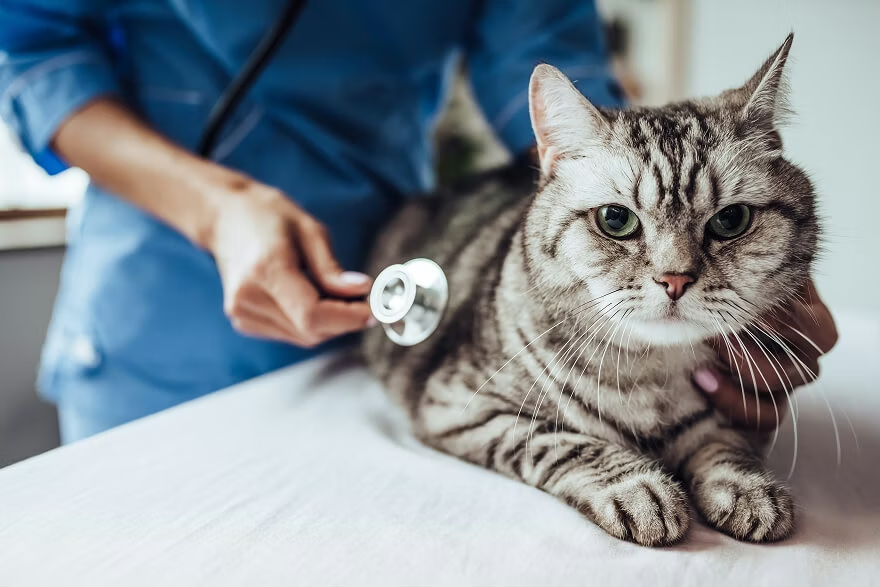
Vision problems, for example, can change how a cat navigates and responds to their surroundings. If you notice behavioral or physical signs that could indicate vision changes, make an appointment with your veterinarian. The sooner you take action, the better, as early diagnosis can improve the chances of successfully managing some eye disorders. Our guide to blindness and vision loss in cats covers common causes and signs to watch for.
Neurological conditions can sometimes produce episodes that resemble staring or unresponsiveness. Age-related cognitive changes may also alter a senior cat’s awareness of and interaction with their surroundings. You can’t diagnose these conditions based on staring alone, but your vet can evaluate this information alongside your cat’s overall health.
If you’re concerned, keep notes about when episodes occur, how long they last, and what your cat does before and afterward. A video can also give your veterinarian useful information, particularly if the behavior is sporadic and unlikely to occur during an appointment.
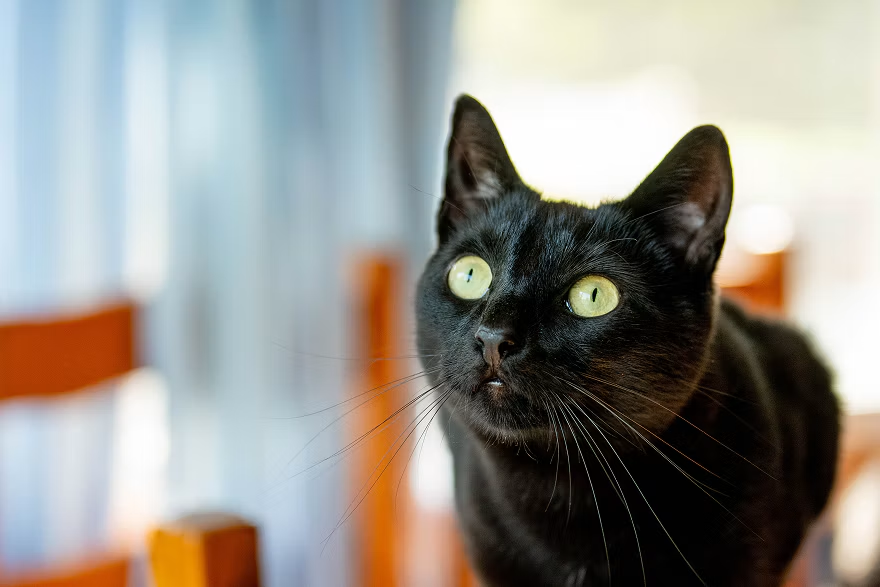
Cats and the supernatural: where folklore comes in
Of course, scientific explanations haven’t stopped humans from wondering if there isn’t something more mysterious to cats’ perceptions.
Cats have been connected to the supernatural in cultures around the world for centuries. In medieval Europe, cats became associated with witchcraft and the devil, while Japanese folklore includes supernatural felines such as the shape-shifting bakeneko and two-tailed nekomata. Their silent movements, reflective eyes, late-night activity, and seemingly inexplicable reactions to their surroundings all add to their mysterious reputation.
These stories are fascinating pieces of cultural history, but no scientific evidence shows that cats can see ghosts, spirits, or other supernatural beings—at least not yet.
Understanding your unique cat
Knowing what’s normal for your cat is one of the best ways to recognize when something changes. Watch for patterns in their behavior, especially as they age, and talk with your veterinarian about any changes.
Genetic information can add another layer to your understanding of your cat. Wisdom Panel Complete for Cats screens for 70+ breeds and populations, 45+ genetic health risks, and 25+ physical traits. Genetic results can’t explain why your cat is staring at the wall or replace a veterinarian’s evaluation. Still, they can provide additional context about their ancestry, traits, and inherited health risks. The more you understand about your cat, the less mysterious their behaviors become.